In recent decades, the predominant approach has been an R&D system led by public research centers. To some extent, this is still the case. As various authors have reported (Diaz-Bonilla et al., 2014; Villalobos et al., 2017), Latin America has pioneered the development of the NARS, with institutes that are accountable to the agricultural ministries and that are aimed at improving agricultural development, among other objectives. Whilst the NARIs were being established, international centers in the CGIAR system were also being created. Examples include the International Centre for the Improvement of Maize and Wheat (Centro Internacional de Mejoramiento de Maíz y Trigo or CIMMYT), the International Center for Tropical Agriculture (Centro Internacional de Agricultura Tropical or CIAT) and the International Potato Center (Centro Internacional de la Papa or CIP). The complexity of the system grew in terms of the number and range of entities, funds, and networks for regional cooperation, such as FONTAGRO, IICA, CATIE (Tropical Agricultural Research and Higher Education Center), CARDI (Caribbean Agricultural Research and Development Institute), and the Network of Ibero-American NARIs (Red de INIAs de Iberoamérica).
The actions of public centers, particularly NARIs, has blurred the line between the generation of technologies and their application. However, there has been a stronger orientation towards applied technologies. This applied orientation places most NARIs in what Ruttan (2001) refers to as ‘Rickover’s quadrant’.[2] This relates to the development of technologies in areas where the commercial benefits of R&D are neither immediate nor evident because of the difficulties for private initiatives to appropriate these benefits.
The key role of NARIs does not hide the growing diversification of the research capacity of individual countries. Therefore, the question of who governs the system does not have an easy answer. According to the ASTI database, the total R&D funding in the agricultural, agri-food, and agribusiness sector from government, universities, and non-profit foundations and associations indicates that NARIs accounted for between 20% (Mexico) and 82% (Panama) of resources allocated to agricultural R&D in 2013. In any case, the NARIs in each country are sufficiently sized to highlight their contribution to the KIS.
Does the government play a crucial role in R&D funding? Most NARIs are financed primarily with government resources. However, in some cases, there is a large contribution from cooperation funds (e.g. Bolivia) or a diversified structure with public and private contributions (e.g. Uruguay and Chile). A limitation of our data is that R&D spending by agribusiness is insufficiently accounted in the ASTI database and other available sources, so non-governmental resources mainly consider universities, private foundations and NGOs. Nevertheless, ASTI provides a first picture of the degree of the government’s involving in R&D spending.
Figure 2 isolates two clusters of countries. The first cluster includes the eight countries with the highest agricultural R&D intensity in the region (> 0.8%). In this cluster the research intensity increases at a rate of 0.19 points when the share of government funding increases by 10 points, with a significant linear relation between both variables (p=0.0037). In the four countries with the highest R&D intensity (Argentina, Brazil, Chile and Uruguay at least 50% of agricultural R&D resources come directly from government sources. The second cluster includes nine countries where the R&D intensity is under 0.8% but the share of government resources is over 50%. In this cluster, a significant share of government funding appears not sufficient to achieve a higher R&D intensity and the relation between research intensity and the share of government funding is not significant (p=0.1407). The cases of Honduras and Peru, not belonging to the defined clusters, are of countries with very low R&D intensity (<0.4) but also with a low share of government in the agricultural R&D spending (<35%).
In short, these findings suggest that increasing government funding in the resource pool is necessary to reach higher rates of R&D intensity, but it does not seem sufficient in some countries with low R&D intensity. Possible reasons, to be further explored, are the insuf ficiency of total public R&D spending and the lack of complementary resources where the KIS is not sufficiently diversified.
Another important aspect of the system is the provision and characteristics of qualified people to meet technological challenges. Stads et al. (2016) showed that there is a tendency towards institutional diversification in agricultural research. By 2013, 45% of researchers were not in specialized government centers. The ASTI database shows notable dispersion in the characteristics of researchers in the LAC countries. A brief analysis of the database for these research staff indicators yields the following results:
• The rate of full-time equivalent (FTE) researchers is 63 per 100,000 farmers. The FTE per million inhabitants is an indicator of the prominence of agricultural R&D in society. There are, on average, 35 researchers per million inhabitants. Again, there is a wide range. Guatemala and Ecuador have fewer than 10, whereas Costa Rica and Chile have more than 50, and Argentina and Uruguay have more than 100.
• The number of researchers with PhDs in LAC 30 years ago was low. The situation has improved substantially (Esquivel et al., 2017). However, ASTI data show that in 2013, only one in five researchers in the agricultural, agri-food, and agribusiness sector had PhDs. The rate of researchers with PhD was above 30% in only three countries (Chile, Mexico, and Brazil) and was below 10% in six countries.
• The rate of young researchers (aged<31 years) is 8%. Colombia has the highest rate, with 24%. At the other extreme is the issue of generational renewal, which is reflected by the percentage of researchers aged over 60 years. This is a challenge in countries such as Peru, Brazil, Argentina, Chile, Mexico, and Uruguay.
• The average percentage of women researchers is 30%. However, in five countries, this percentage is less than 20%, and only three countries have more than 40%. Therefore, gender equality remains a challenge for the system.
• Based on the information from the NARIs for this study, the percentage of PhDs grew in five of the seven NARIs that provided data for the period between 2013 and 2018. There were substantial increases in Chile and Uruguay, with the Uruguayan NARI reporting that it has more than 50% PhDs.
< 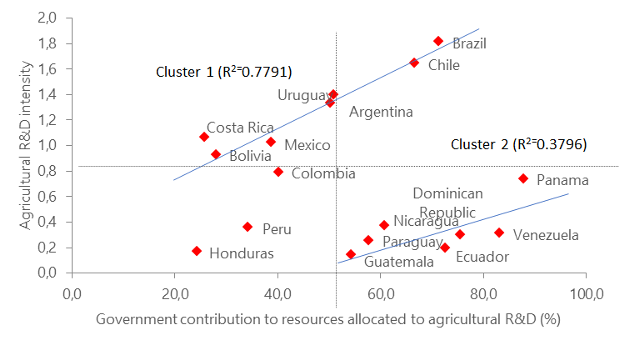 Figure 2. Agricultural R&D intensity vs government contribution to total resources for agricultural R&D in LAC countries. Source: Authors’ ellaboration based on data from the ASTI database (2013)
What is being governed?
A considerable portion of the data from the institutes refers to their strategic directions: their vision, mission, and objectives. These data have been used to gather the concepts that appear explicitly in these strategic directions. The fact that an idea is not explicitly stated in an institute’s strategic direction does not mean that it has not been paid sufficient attention. It is also possible that a specific concept is considered to be closely related to others. All institutes form part of the science policy. Therefore, it is assumed that research and dissemination of knowledge is their raison d’être. The explicit reported strategic directions are presented in Table 3.
The most prominent concepts are those of research, knowledge generation, innovation, and technology development and transfer. Many institutes have strategic directions related to promoting sustainability, citizens’ well-being, and development. The improvement of productivity and competitiveness was expressly mentioned by 11 institutes, nine of which showed an explicit interest in companies in the agricultural, agri-food, and agribusiness sector. The objectives relating to food security and sovereignty were shared by five institutes. Those relating to nutrition and consumption were likewise expressed by five. One of these also expressed a strategic interest in food security.
Some directions might be in the minority either because they were considered to have been covered implicitly or because they were not historically considered priorities amongst the objectives of the NARIs. This group includes directions related to inclusiveness, multiculturalism, resilience, and SDG. A few institutes also cited internationalization and support for the public administration as key aspects. Finally, 10 of the 20 institutes expressed a desire to continue acting as a model within the NARS.
Results of the internal evaluation
For each of the six governance dimensions, the analysis was performed to calculate the number of institutes which expressed strengths or challenges in relation to each strategic objective (see Table 4). In each dimension, the arithmetic mean was calculated for the number of mentions of objectives in terms of strengths or challenges within each corresponding dimension. For example, a value of 3.4 in the directionality dimension means that an average of 3.4 institutes (out of a maximum of 20) mentioned a strategic objective in that dimension as a strength.
As for strengths, the three dimensions with the highest average number of mentions were directionality, capacity building, and coordination and cooperation. The three dimensions with the lowest average number of mentions as strengths were demand articulation, evaluation and learning, and improvement in management, with the latter receiving the lowest number of mentions.
The most rarely mentioned challenges (fewer than three mentions) were evaluation and learning and improvement in management.The four dimensions most frequently considered challenges were directionality, coordination and cooperation, capacity building, and demand articulation.
The specific strategic objectives with the highest number of mentions as a strength or challenge are shown in Table 5. The strategic objectives can be placed into four groups. This grouping yields four types of recommendations:
− First, there are objectives that some countries consider a strength but few or none consider a challenge. These objectives are to be ‘maintained’. Specifically, these objectives are ‘to achieve a country-wide presence and cooperate with regional actors’, ‘to be supported by a legal framework as the coordinator of the KIS in the agricultural, agri-food and agribusiness sector’ and ‘to formally participate in complex international partnerships’.
− Second, there are objectives that few countries consider a strength but some see it as a challenge. These objectives are to be ‘driven forward’. In total, 16 objectives have these characteristics.
− Third, there are objectives that few countries mention as either strengths or challenges. For these objectives, the recommendation would be for ‘reflection’. It is unclear whether these are actually unnecessary or whether the institutes are simply unaware that they are necessary. There are 21 such objectives.
− Fourth and finally, there are objectives that some countries mention as a strength and others as a challenge. There are 11 of these objectives. Here, the recommendation would be to ‘cooperate’. This means establishing partnerships to join forces or exchange experiences.
Correlations between reported mentions to challenges for each pair of strategic dimensions were estimated for the sample of NARIs.[3] The highest correlation coefficients were found between capacity building and evaluation and learning (0.942), and between capacity building and coordination and cooperation (0.854). Improvement in management shows the lowest correlations with the other dimensions, with a maximum correlation of 0.408 with coordination and cooperation. Management is therefore considered as hardly linked with the rest of strategic dimensions. Directionality shows a correlation coefficient of 0.742 with coordination and cooperation suggesting a possible association between both dimensions, in particular through networking with private and public actors.
Table 3. Number of mentions of the main concepts used in their goals, vision, mission and strategic objectives of the 20 consulted institutes
Source: Compiled by the authors based on the 17th Meeting of Ibero-American NARIs (XVII Encuentro de INIA de Iberoamérica) in Guayaquil, October 2018
Table 4. Average number of mentions of an objective as a challenge or strength for each governance dimension
Source: Compiled by the authors from the reports presented by the institutes participating in the Guayaquil workshop
Table 5. Most frequently mentioned strategic objectives
Source: Authors’ ellaboration from the reports presented by the institutes participating in the Guayaquil workshop
Results of the external evaluation
The results of the external evaluation are examined using mapping (Fig. 3). This mapping shows the evaluations made by the work team. The dimensions in the upper
right quadrant are highly important and highly developed. These are the key factors. Those located in the lower right quadrant are factors that should be maintained.
Similarly, important opportunities or areas in the short, medium, and long term can also be identified. The strategic objectives or dimensions located in the upper part of the lower right quadrant are medium-term priorities. The strategic actions or dimensions located in the lower right quadrant are long-term priorities. Hence, the strategic importance of these factors is still at an early stage. Taking the average for each dimension by strategic objective shows that the key factors (relatively high importance and high stage of development) are capacity building and coordination and cooperation. Improvement in management is a short-term priority. Evaluation and learning and demand articulation are medium-term priorities. Finally, directionality is a long-term priority.
The dimensions can be classified into three groups according to the average difficulty of implementation: (i) low difficulty (directionality, coordination and cooperation, and demand articulation), (ii) medium difficulty (improvement in management) and (iii) high difficulty (evaluation and learning and capacity building).
The coordination and cooperation dimension is cited as a key factor. However, its implementation does not seem to entail a high degree of difficulty. The capacity building continues to require special attention (PhDs and laboratories cannot be created on an ad hoc basis). In the short term, improvement in management is of medium difficulty and is at a low stage of development. The areas that should be planned for as medium- and long-term objectives are evaluation and learning, demand articulation, and directionality. Implementing suitable mechanisms to evaluate processes and results might prove more difficult. These mechanisms require a strong commitment from the institutions and communities involved.
 Figure 3. Assessment of strategic dimensions of NARIs by importance and stage of development. Source: Authors’ elaboration based on the external evaluation of NARIs’ governance.
DiscussionTop
A KIS comprises multiple public and private actors that interact with one another. A deal of published research on innovation systems in Latin America has emerged in recent years (Hartwich et al., 2007; Villalobos et al., 2017; Devaux et al., 2018). Most of this studies emphasize how linear and hierarchical transfer systems are progressively being abandoned. In general, this paper corroborates the NARIs’ position as an essential node in the KIS in most Ibero-American countries.
The role of public investment as the driver of agricultural research in Latin America remains fundamental. As observed in the first part of the Results section, the the absence of public funding of R&D resources is an important factor behind relatively low R&D intensity, although a high share of government funding is not always sufficient for high R&D intensity. Private investment in R&D plays a key role. The literature provides detailed discussions of the complementarity or substitutability of public and private R&D spending (David et al., 2000; Mas-Verdu et al., 2016) and the present study underlines that a significant share of public funding is not sufficient per se to increase R&D intensity. Recent studies (Marino et al., 2016; Choi & Le 2017) have also indicated the absence of the substitutive effects of private and public investment in R&D. Our research suggests that the public sector and the NARI in particular can provide the right infrastructure to support research and innovation.
Nevertheless, there is a shortage of high-quality statistics on the role of companies in innovation activities that target the agricultural, agri-food, and agribusiness sector. Timely data on the volume of R&D expenditure by the private business sector are lacking, and should continue the efforts initiated by previous databases (Norton, 2011; Stads et al., 2016).
The analysis of the governance of NARIs identified 51 strategic actions or objectives for effective governance. The proposed method can provide a basis for further strategic analysis and monitoring of the institutes based on the six governance dimensions of coordination and cooperation, capacity building, improvement in management, evaluation and learning, demand articulation, and directionality.
As a strength, the key dimension of NARIs appears to be coordination and cooperation. This result was acknowledged in the internal and external evaluations and supports previous research on the relevance of innovation networks in Latin America (Geldes et al., 2017). In the agricultural and food sector, there are consolidated regional networks such as FONTAGRO, which articulates more than 167 public-private innovation platforms, MasAgro (Sustainable Modernization of the Traditional Agriculture, a participatory improvement of maize with the National Institute of Agricultural and Livestock Forest Research, Mexico, and CIMMYT), or Network of Ibero-American NARIs.
By contrast, as a challenge, the key dimension appears to be demand articulation, followed closely by capacity building. Most institutes are enhancing the integration of public research within the KIS. However, this is achieved through close links with users and social demands, as well as a strong supply of highly qualified human resources.
Comparing the external and internal evaluations reveals some discrepancies. For example, internally, many of the evaluated institutes do not perceive improvement in management to be a high priority, except of project management. However, the external evaluation highlights it as a clear priority for short-term implementation. The administrations might still have to internalize certain objectives such as transparency, gender equality, and social responsibility.
Many of the specific strategic objectives with high scores in the internal and external evaluations refer to the way the institutes are linked to the KIS, R&D capabilities, and effective process management. The strategic objectives in Table 6 were considered high-priority challenges in the internal evaluation and highly important in the external evaluation. They are specific strategic objectives from the dimensions of directionality, demand articulation, improvement in management, and capacity building.
Certain strategic objectives received a few mentions as strengths. This low number of mentions might not necessarily imply that the institutions are weak in these areas; they might simply not have considered the objective relevant enough to highlight in the report. This is true of those related to evaluation and learning. These objectives received a few mentions as strengths or challenges. Notably, there was also little or no mention of objectives such as ‘to promote spin-offs and technology-based companies’, ‘to promote staff mobility in firms and the private sector’ or ‘to build suitably sized research teams’. While multi-actor participatory approaches are becoming more and more common in agricultural research (Waddington & White, 2014; Devaux et al., 2018), NARIs have not yet become fully operational as innovation platforms, considered as knowledge intermediaries (Kilelu et al., 2013). Neither the improvement in management objectives related to social responsibility nor those related to gender equality were mentioned as strengths or challenges, though these aspects are increasingly considered an asset for international research institutions (McCluskey, 2019).
Table 7 reflects the key recommendations arisen from the results for the whole Ibero-american network of NARIs previously summarised. The two columns include the required strategic actions, derived from the internal evaluation, and the priorities, derived from the external evaluation. Some dimensions that are more frequently cited as strengths and challenges are posible areas of inter-institutional and international collaboration. Among these, coordination and cooperation, and capacity building are considered key priorities, and directionality as a long-term priority. Demand articulation is more frequently mentioned as a challenge, suggesting the need to move forward towards more applied knowledge transfer. The external evaluation considers this dimension as a medium-term priority. Evaluation and learning, and improvement in management, are not frequently considered internally as major challenges or as strengths. However, the external evaluation confirms the short-term priority of improvement in management and the need to improve evaluation and learning with a medium-term perspective, so the institutes should not avoid to reflect on upgrading both dimensions in their goverance strategies.
Six fundamental policy implications can be drawn from this study:
1. Capacity building keeps a key dimension for NARIs, oftenly linked to demand articulation and collaboration in innovation activities. It would be advisable to extend strategies to generate income to enhance and complement public support and provide firmer financial sustainability. Actions may consist of public-private consortia to handle research programs as well as small-scale initiatives. Private contributions can be made to provide applied solutions to benefit agricultural and rural communities.
2. Governance models should encourage greater involvement by the private sector, businesses, foundations, universities, and agricultural and rural communities. The approach should not be one of rivalry but rather of synergy between public and private undertakings in order to update research directionality and to collaborate in innovation activities.
3. Setting up effective administrative and financial management systems, as well as systems for linking or managing research, is a clear short-term priority for NARIs. While improvement in management is not usually considered as a dimension linked with the rest of strategic dimensions, it is essential to identify areas where the administrative system can be simplified to remove obstacles that prevent linking the institutes with the rest of the system and engaging in international cooperation.
4. The implementation of suitable mechanisms to evaluate processes and outcomes appears to be essential. A strong commitment is needed from the institutions and the communities that work with them. The IDB (Inter-American Development Bank), CGIAR, and national research institutions in Ibero-America should continue collaborating to strengthen the ASTI database to provide statistics on the R&D system for LAC, at least every two years.
5. It is important to reflect on the scope, vision, and mission of the research institutes so that they can adapt to the challenges of this century. The NARIs strategic mission must be determined by a deeper asssessment of the roles of the state in the agricultural KIS (Borras & Edler, 2020). As for the scope, the importance of directions related to inclusiveness, multiculturalism and resilience is highlighted by the growing literature on agricultural innovation. The NARIs should consider more explicit guidelines on climate change, SDG, and inclusive development, with an ongoing focus on areas related to famine, nutrition, and family farming.
6. We recommend to prioritize areas of governance where cooperation between institutes can have positive outcomes. In our inquire to NARIs, certain objectives were mentioned as a challenge by some institutes and as a strength by others. Examples include the objectives ‘to hire qualified and up-to-date human resources with PhDs and MScs’, ‘to diversify funding with resources from external, public and private sources’, ‘to anticipate long-term technological trends and make them a strategic priority’ and ‘to achieve a systematic link between knowledge and practice’.
Our method of analysis nonetheless has certain limitations. First, the method allows to count the institutes’ references to the strategic objectives but not the intensity of contributors’ support to each objective. Second, a subgroup of specific objectives were mentioned as neither a strength nor a challenge. Governance practices whose importance was not highlighted or was considered to have already been achieved should not be overlooked. Examples are the objectives referring to social responsibility and gender equality. Further research is needed to identify the underlying social and cultural factors behind the apparent lack of consideration of such objectives. Third, as mentioned earlier, some institutes provided more detailed information than others. These differences led to a varying number of dimentions of certain objectives. A fourth caveat is that the external evaluation identified some objectives that might be relevant for strategic planning, despite not being highlighted in the internal evaluation. Fifth, differences in strategic objectives expressed by the NARIs can be further studied to define commonalities of challenges and priorities. Finally, a deeper consideration of all the drivers of R&D intensity in the agri-food sector is needed to understand country differences in the effectiveness of public R&D funding. In spite of these limitations, this study offers a starting point to discuss and eventually implement standardized questionnaires within the framework of the strategic planning backed by FONTAGRO for 2025 and for the monitoring of the Ibero-American NARIs’ network.
Table 6. Specific objectives considered high-priority challenges
Source: Internal and external evaluation reports of the agricultural research institutes.
Table 7. Recommended actions and priorities for the Ibero-American network of NARI.
Source: Internal and external evaluation reports of the agricultural research institutes (see Table 4 and Fig. 3).
AcnowledgementsTop
Authors’ are grateful to Dr. Rocio Lansac and Dr. Jose-Luis Alonso-Prados for their coordination of the information collection stage and specific comments to previous draftss.
|
[1]
| In the European Union, the abbreviation ‘AKIS’ is used to refer to the agricultural knowledge and innovation system within the scope of Horizon 2020.
|
|
[2]
| Admiral Hyman Rickover developed the first nuclear plant not for commercial use but as an energy source for naval vessels.
|
|
[3]
| The basic data for correlations and the correlation matrix can be supplied at authors’ request.
|
ReferencesTop
|
|
|
○
|
Bergek A, Jacobsson S, Carlsson B, Lindmark S, Rickne A, 2008. Analyzing the functional dynamics of technological innovation systems: a scheme of analysis. Research Policy 37 (3): 37-59. https://doi.org/10.1016/j.respol.2007.12.003 |
|
○
|
Borras S, 2009. The widening and deepening of innovation policy: what conditions provide for effective governance? (No. 2009/2). Lund University, CIRCLE-Center for Innovation, Research, and Competences in the Learning Economy.
|
|
○
|
Borrás S, Edler J (eds), 2014. The governance of socio-technical systems. Explaining change. Edward Elgar Publ, Cheltenham. https://doi.org/10.4337/9781784710194
|
|
○
|
Borrás S, Edler J, 2020. The roles of the state in the governance of socio-technical systems' transformation. Research Policy 49 (5): 103971. https://doi.org/10.1016/j.respol.2020.103971 |
|
○
|
Bortagaray I, 2016. Políticas de ciencia, tecnología, e innovación sustentable e inclusiva en América Latina. UNESCO, Oficina de Montevideo. |
|
○
|
Braun V, Clarke V, 2006. Using thematic analysis in psychology. Qual Res Psychol 3(2): 77-101. https://doi.org/10.1191/1478088706qp063oa
|
|
○
|
Carayannis EG, Grigoroudis E, Campbell DF, Meissner D, Stamati D, 2018. The ecosystem as helix: an exploratory theory‐building study of regional coopetitive entrepreneurial ecosystems as quadruple/quintuple helix innovation models. R&D Manage 48(1): 148-162. https://doi.org/10.1111/radm.12300 |
|
○
|
Chema SG, Roseboom JE, 2003. A review of key issues and recent experiences in reforming agricultural research in Africa. Res Rep 24. ISNAR, The Hague. |
|
○
|
Choi J, Lee J, 2017. Repairing the R&D market failure: public R&D Subsidy and the composition of private R&D. Research Policy 46 (8): 1465-1478. https://doi.org/10.1016/j.respol.2017.06.009 |
|
○
|
Datta A, 2018. Strengthening research systems: concepts, actions, and actors, K4D Helpdesk Report. Institute of Development Studies, Brighton, UK. |
|
○
|
David PA, Hall BH, Toole AA, 2000. Is public R&D a complement or substitute for private R&D? A review of the econometric evidence. Research Policy 29: 497-529. https://doi.org/10.1016/S0048-7333(99)00087-6
|
|
○
|
Delvenne P, Thoreau F, 2017. Dancing without listening to the music: learning from some failures of the 'national innovation systems' in Latin America. In: Research handbook on innovation governance for emerging economies. pp: 37-58. Edward Elgar Publishing. https://doi.org/10.4337/9781783471911.00007 |
|
○
|
Devaux A, Torero M, Donovan J, Horton D, 2018. Agricultural innovation and inclusive value-chain development: a review. J Agribus Dev Emerg Econ 8 (1): 99-123. https://doi.org/10.1108/JADEE-06-2017-0065 |
|
○
|
Díaz-Bonilla E, Saini E, Henry G, Creamer B, Trigo E, 2014. Global strategic trends and agricultural research and development in Latin America and the Caribbean: A framework for analysis. International Center for Tropical Agriculture (CIAT). Cali, Colombia. |
|
○
|
Dutrénit G, Natera JM, 2017. Procesos de diálogo para la formulación de políticas de CTI en América Latina y España. CLACSO, Buenos Aires.
|
|
○
|
Edler J, Fagerberg J, 2017. Innovation policy: what, why, and how. Oxford Rev Econ Policy 33 (1): 2-23. https://doi.org/10.1093/oxrep/grx001 |
|
○
|
Esquivel P, Orjuela A, Barros MP, Osorio C, 2017. Potential opportunities and challenges for research collaboration with Latin America in agriculture and food science. J Agr Food Chem 65 (37): 8096-8098. https://doi.org/10.1021/acs.jafc.7b03572 |
|
○
|
Francis JA, Van Huis A, 2016. Introduction. Why focus on innovation systems: implications for research and policy. In: Innovation systems, pp. 8-13. The Technical Centre for Agricultural and Rural Cooperation (CTA), Wageningen.
|
|
○
|
Geldes C, Heredia J, Felzensztein C, Mora M, 2017. Proximity as determinant of business cooperation for technological and non-technological innovations: a study of an agribusiness cluster. J Bus Ind Market 31 (1): 168-179. https://doi.org/10.1108/JBIM-01-2016-0003 |
|
○
|
Guest G, MacQueen KM, Namey EE, 2011. Applied thematic analysis. Sage Publ, Thousand Oaks, CA, USA. https://doi.org/10.4135/9781483384436 |
|
○
|
Hartwich F, Alexaki A, Baptista R, 2007. Innovation systems governance in Bolivia: Lessons for agricultural innovation policies. IFPRI Discussion Paper 00732, December 2007. International Food Policy Research Institute, Washington DC. |
|
○
|
Havas A, Weber KM, 2017. The 'fit' between forward-looking activities and the innovation policy governance sub-system: A framework to explore potential impacts. Technological Forecasting and Social Change 115: 327-337. https://doi.org/10.1016/j.techfore.2016.07.016
|
|
○
|
Hillman K, Nilsson M, Rickne A, Magnusson T, 2011. Fostering sustainable technologies: a framework for analyzing the governance of innovation systems. Sci Publ Policy 38 (5): 403-415. https://doi.org/10.3152/030234211X12960315267499 |
|
○
|
Howlett M, 2009. Governance modes, policy regimes, and operational plans: A multi-level nested model of policy instrument choice and policy design. Policy Sci 42: 73-89. https://doi.org/10.1007/s11077-009-9079-1 |
|
○
|
Jaramillo H, Lugones F, Salazar M, 2000. Normalización de indicadores de innovación tecnológica en América Latina y el Caribe: Manual de Bogotá, Doc. 21557, CO-BAC, Bogotá.
|
|
○
|
Kilelu CW, Klerk L, Leeuwis C, 2013. Unraveling the role of innovation platforms in supporting co-evolution of innovation: Contributions and tensions in a smallholder dairy development program. Agr Syst 118: 65-77. https://doi.org/10.1016/j.agsy.2013.03.003 |
|
○
|
Lupova-Henry E, Dotti NF, 2019. Governance of sustainable innovation: Moving beyond the hierarchy-market-network trichotomy? A systematic literature review using the 'who-how-what' framework. J Clean Prod 210: 738-748. https://doi.org/10.1016/j.jclepro.2018.11.068 |
|
○
|
Marino M, Lhuillery S, Parrotta P, Sala D, 2016. Additionality or crowding-out? An overall evaluation of public R&D Subsidy on private R&D expenditure. Research Policy 45 (9): 1715-1730. https://doi.org/10.1016/j.respol.2016.04.009 |
|
○
|
Mas-Verdu F, Ortiz-Miranda D, García-Álvarez-Coque JM, 2016. Examining organizational innovations in different regional settings. J Bus Res 69 (11): 5324-5329. https://doi.org/10.1016/j.jbusres.2016.04.132 |
|
○
|
McCluskey JJ, 2019. Why diversity and expectations matter. Agr Econ 50: 107-111. https://doi.org/10.1111/agec.12530 |
|
○
|
OECD, 1999. Managing innovation systems. OECD, Paris. https://www.oecd.org/science/inno/2101733.pdf [March 2020]. |
|
○
|
Norton GW, 2011. Impact assessment of the IFPRI agricultural science and technology indicators (ASTI) project. International Food Policy Research Institute, Washington DC. |
|
○
|
Pound B, Conroy C, 2017. The innovation systems approach to agricultural research and development. In: Agricultural systems. Agroecology and rural innovation for development; Snapp S, Pound B (eds). Academic Press, Elsevier, London, pp: 371-405. https://doi.org/10.1016/B978-0-12-802070-8.00011-6 |
|
○
|
Ruttan VW, 2001. Technology, growth, and development: an induced innovation perspective. Oxford Univ Press, NY. |
|
○
|
Schot J, Steinmueller W, 2018. Three frames for innovation policy: R&D, systems of innovation and transformative change. Research Policy 47 (9): 1554-1567. https://doi.org/10.1016/j.respol.2018.08.011 |
|
○
|
Spielman DJ, 2005. Innovation systems perspectives on developing-country agriculture: A critical review. ISNAR Discussion paper No. 591-2016-39898. Int Policy Res Inst, Washington DC. |
|
○
|
Stads GJ, Beintema N, Pérez S, Flaherty K, Falconi C, 2016. Investigación agropecuaria en Latinoamérica y el Caribe. Un analisis de las instituciones, la inversion y las capacidades entre países. Inst Int Invest Pol Alim Banco Interamericano de Desarrollo, Washington DC: |
|
○
|
Steurer R, 2007. From government strategies to strategic public management: an exploratory outlook on the pursuit of cross‐sectoral policy integration. Eur Environ 17(3): 201-214. https://doi.org/10.1002/eet.452 |
|
○
|
UNDP, 2004. Strategy note on governance for human development. United Nations Development Program, New York. |
|
○
|
Villalobos VM, García M, Avila F, 2017. La innovación para el logro de una agricultura competitiva, sustentable e inclusiva, Instituto Interamericano de Cooperación para la Agricultura, San José. Fundación Colegio de Postgraduados en Ciencias Agrícolas, México. |
|
○
|
Waddington H, White H, 2014. Farmer field schools: from agricultural extension to adult education, systematica review summary. Int Init for Impact Eval, Washington DC. https://doi.org/10.23846/SRS001ffs |